
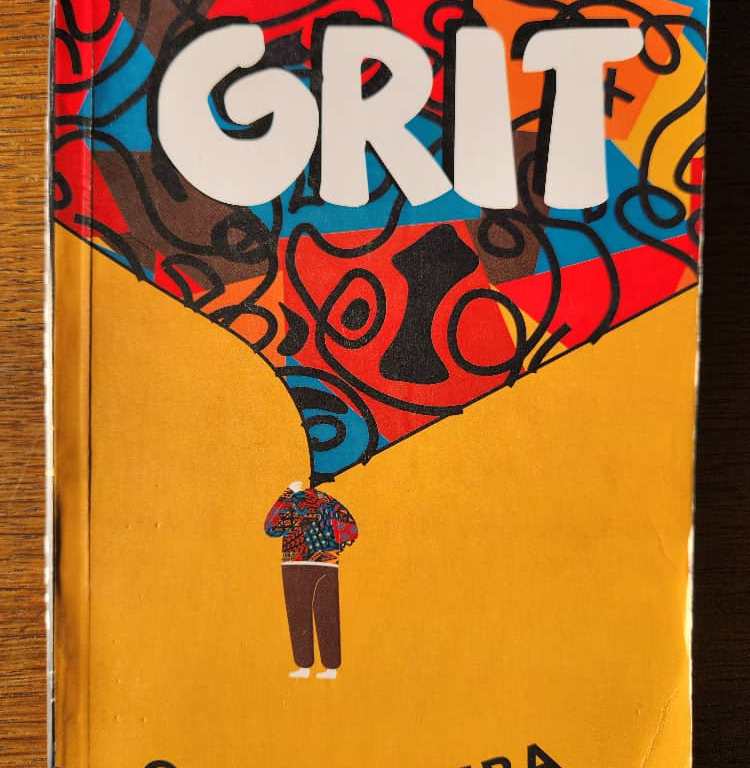

Obari Gomba is a poet, playwright, and academic at the University of Port Harcourt. His play, Grit, won the prestigious Nigeria Prize for Literature in 2023. The play has an episodic plot, as it begins at the end when Pa Nyimenu’s family is enmeshed in violence among rioters, party thugs, and policemen. With the use of flashbacks, we get connected with the origin and progression of the conflicts that culminate in an apocalyptic climax. The deployment of dramatic irony, twists and turns, idiomatic and witty expressions, symbolism, and apt metaphors makes the play fascinating in depicting the political intrigues and chicanery that occasion personal and communal disillusionment, grief, betrayal, and vendetta. The conflict begins with the quests of two brothers, Oyeslloand Okote, to run for a constituency bye-election on the platforms of opposing political parties, the Democratic People’s Alliance (DPA) and the United Progressives Party (UPP).
Grit raises the question of motive in political participation because why people participate in politics has fundamental relevance in a democracy. The play can be read as a tale of two brothers and ex-soldiers, Oyesllo and Okote, whose motives for getting into politics are geared towards avenging past hurts. Gomba presents Oyesllo as an allegory of some former or retired military officers who venture into politics for reasons other than patriotism and service. The playwright censures the Nigerian military and its administrative system because despite his service to his fatherland and clean military record, Oyesllo, a retired army officer, could not get his pension from the government. He feels humiliated because he cannot cater to the education and other needs of his children, who have been sent to their maternal home for economic survival. To compound his predicaments, he is denied any placement in the army because he uses a prosthetic limb, having suffered harm in a battle while serving his country.
Oyesllo attempts to invest his severance benefit in a business, but, unfortunately, he is defrauded. Desperate for some relief and alternatives, he considers politics a viable career to “rehabilitate” his battered life and finances. This is where the playwright makes us question our views about politics as a career, especially in developing nations. Oyesllo’s disillusionment and grief undergird his defective view of politics: “Politics is war by other means” (6). He is an overt advocate of the Machiavellian principle of the end justifying the means, as he unapologetically affirms that political positions are reserved for the violent. He uses the metaphor of a shark-infested ocean to limn his country. For him, it is “time to adapt and swim with the sharks” (11). He is deeply hurt by his predicament arising from how the military system has treated him, to the extent that he easily hurts others, including his wife, Nmade, whom he accuses of having sexual affairs with his brother, Okote. Oyesllo is also aggrieved towards his parents, whom he sees as being partial for enrolling him in the military, unlike Okote, who was sent to the university to study medicine. Moreover, Oyesllo and Okoto are hurt and traumatised by the memory of the death of their mother, an activist, who was shot for defending the rights of the women of Sonofa to trade without the harassment of the government’s task force.
Again, Grit explores the impact of personal trauma and loss on the characters’ motivation to venture into politics. Haunted by the memory of Mama’s death, forty-five-year-old Okote, also a retired military officer, is plagued by the guilt of leaving his mother and home unprotected because of his commitment to defend his fatherland. His candidacy for the constituency bye-election is a revenge mission against the DPA, whose government oversaw the death of his mother. As Pa Nyimenu puts it, “You can forgive a man who has injured you with a knife, but you will always be uncomfortable each time he carries a knife” (51). Moreover, to avoid what he calls the moral baggage of the UPP, Okote decides to run as an independent candidate. Ironically, Oyesllo wins the ticket of the DPA and turns down Okote’s demand that he dumps the DPA. Oyesllobelieves that although the DPA masterminded the killing of his mother, he should “blend with those political pigs, topple them, recreate the system, and give people-orientated governance to our constituents” (12). Hissincerity in this regard is questionable because of his view about politics as a place or career for financial rehabilitation, instead of service to the people.
We are prone to empathise with Pa Nyimenu, whose inability to constrain his warring children rends the fabric that binds his family. Although he does his best to ensure peace in his family, Oyesllo’s overweening ambition hinders every call for harmonious living. Pa Nyimenu’sdescription of victims of political power matches the character of Oyesllo: “Sometimes, the victims of power become enablers of evil because we are all not as morally smart as we often claim we are” (2). Oyesllo has no people-centric plans but is driven by avarice, opportunism, and vindictiveness. Peaceful negotiations to end the raging feud between him and his brother are not his ideal strategy; instead, he believes that “where peace refuses to come by negotiation, it will come by conquest” (49). In a bid to have Okote step down to avoid divided votes and give him an easy sail in the election, Oyesllo plays on the fact that Okote is an adopted son. He does this to further his argument that he is the most qualified to avenge the death of their mother by contesting the bye-election and dismantling a buccaneerish political system.
The dramatic irony that ensues unveils the sinister plot by Bambo, Townse, Matefi, Yasuo, and Kakwa to pitch Oyesllo and Okote against each other in a political duel that should leave both of them defeated and damaged. Bambo and Focco are desperate politicians who instigate and sponsor the trigger-happy goon, White-Eye, and his gang of hoodlums to burn the party secretariat of the UPP. Violence is their preferred tool for capturing political power. This is where the playwright flaunts the systemic rot in the political system. We are very familiar with the politics of violence and calumny displayed by the aforementioned characters because it is the kind of that characterise the political landscape of many postcolonial and developing countries. Moreover, Matefi and the women of Sonofa are the DPP’s tools of deception and manipulation. They claim to endorse the candidacy of Okote, but it is a ploy to pitch him against Oyesllo because they perceive that both brothers are not likely to dance to the tunes of an influential cabal of political pillagers. Oyesllo and Okote do not recognise this dramatic irony and machination, but Nmadedoes. She chides Matefi and the women of Sonofa for attempting to set Pa Nyimenu’s family on fire.
Bambo (Constituency Head of the DPA), Townse(Constituency Head of the UPP), Matefi (Leader of SonofaWomen), and Kakwa (DPO and representative of the law enforcement agency), finaglers of the major conflict, are glued in an unholy alliance to control political power in their constituency by all means. They consider the candidacy of either Oyesllo or Okote as a threat to their grip on power. Townse makes this clear when he explains why he is a part of the plot against the two brothers:
I did not buy into this project for vendetta. It is business. It is power and profit. If my interest is not guaranteed here, I will move elsewhere. A party is just a vehicle, a means to an end. The brothers have public appeal, and if they secure public support, our days of control are over. (78)
Townse’s act of “kindness” to get Okote out of police detention, Matefi’s mobilisation of the gaslighted women to have Okote run for the bye-election against the DPA, and Bambo’s support of Oyesllo to get the DPA’s ticket are all devious and perfidious strategies to distract the two brothers, pitch them against each other, kick them out of the political equation, and eventually make Yasuo their puppet, the sole candidate for the election. They intend to achieve this by stage-managing a free-for-all fight instigated and executed by hired thugs on the night of the political debate between Oyesllo and Okote. This is intended to provide the corrupt DPO Kakwa justifiable reasons to arrest the two brothers on the grounds of instigating violence. The election will be postponed; the brothers, banned from contesting; and then Yasuo will emerge as a consensus candidate of the two parties. Here is an indictment of the security agencies of the country vis-à-vis their roles in aiding and abetting political intimidation and crimes by the elite.
The theme of revenge stands out because the major characters (Oyesllo, Okote, Matefi, Bambo, and Pa Nyimenu) are all out to take their pound of flesh from their detractors. Oyesllo and Okote are out to avenge the murder of their mother by dismantling a viciously pernicious political system. Matefi is on a revenge mission against Oyesllo and his late mother, both of whom disallowed the marriage between her daughter and Oyesllo. Bambo buysinto the vendetta against Pa Nyimenu because his uncle was charged with and convicted of murder on the testimony of Pa Nyimenu. Towards the end of the play, Pa Nyimenuavenges the humiliation of his sons by ordering his allies to burn the house in which the villains Bambo, Townse, Matefi, Yasuo, and Kakwa are meeting to review their plot against his sons.
The message couched in Grit is unambiguous: everyone is motivated to participate in politics for a reason. While the didactic flavours of integrity, unity, harmonious living, and patriotism in Gomba’s play cannot be easily missed, his ideological inclination also needs to be foregrounded. Gomba does not subscribe to docility in a system that leaves citizens at the periphery of governance and the mercy of power-drunk politicians and their allies. His dramaturgy negates unfruitful negotiation for political and socio-economic equity and tolerance of the forces of evil. Gomba’s ideological inclination in Grit is expressed through Pa Nyimenu, “Let them not escape. Let our people shoot them and their boys. And set that guest house on fire. There are two ways to define grit; both fit me tonight” (84-85). In the end, Grit confronts us with some realities, namely, evil has a staying power and there are powerful figures in every society whose aim is to shroud the truth. Hence, good men who intend to fight evil must never take a break or shy away from participating in politics and must be dauntless and prepared to suffer for a long time, if need be.
Dr. Valentine Chimenem Owhorodu lectures at the Captain Elechi Amadi Polytechnic, Port Harcourt, where he teaches Use of English and Literary Appreciation. He holds a BA in English, an MA in Literature, a Diploma in Theology, a PGD in Education, and a PhD in Literature. A literary critic, his areas of interest are Niger Delta literature, eco-literature, war literature, literature and trauma studies, among others. He is the author of Quiet Time Experience and Overcomers. Valentine is married to Flora O. Owhorodu, and they live with their lovely children, Ekwuoma and Igwugwukamma, in Port Harcourt.
 ArtisansQuill| Celebrating Wordcraft