
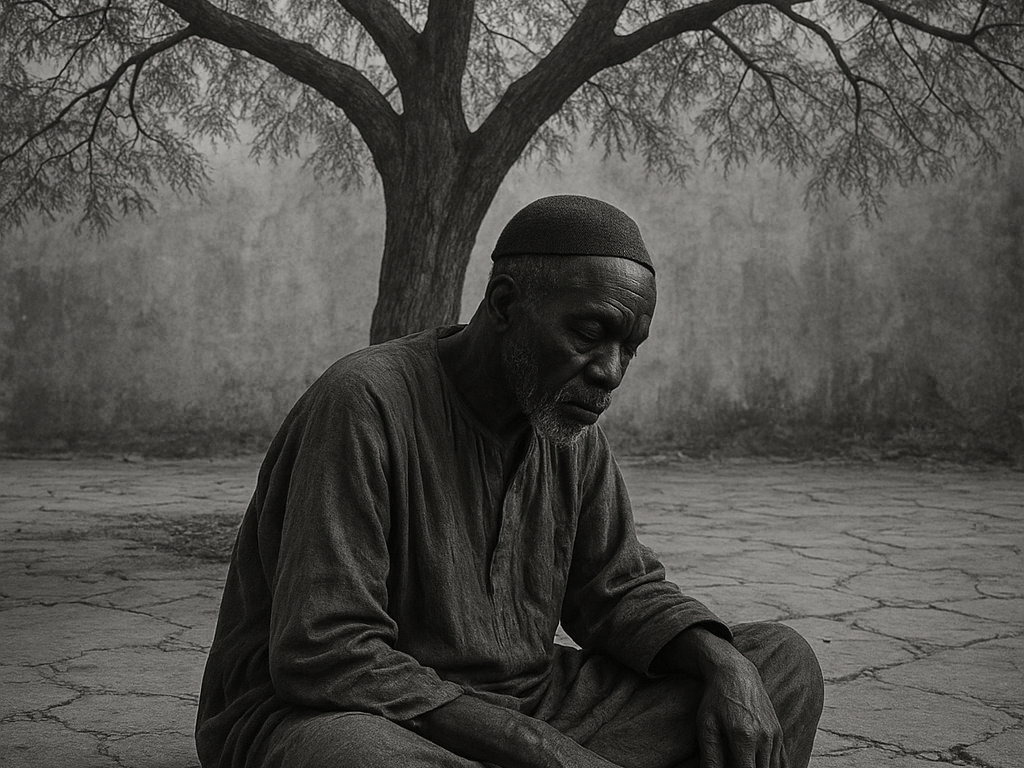
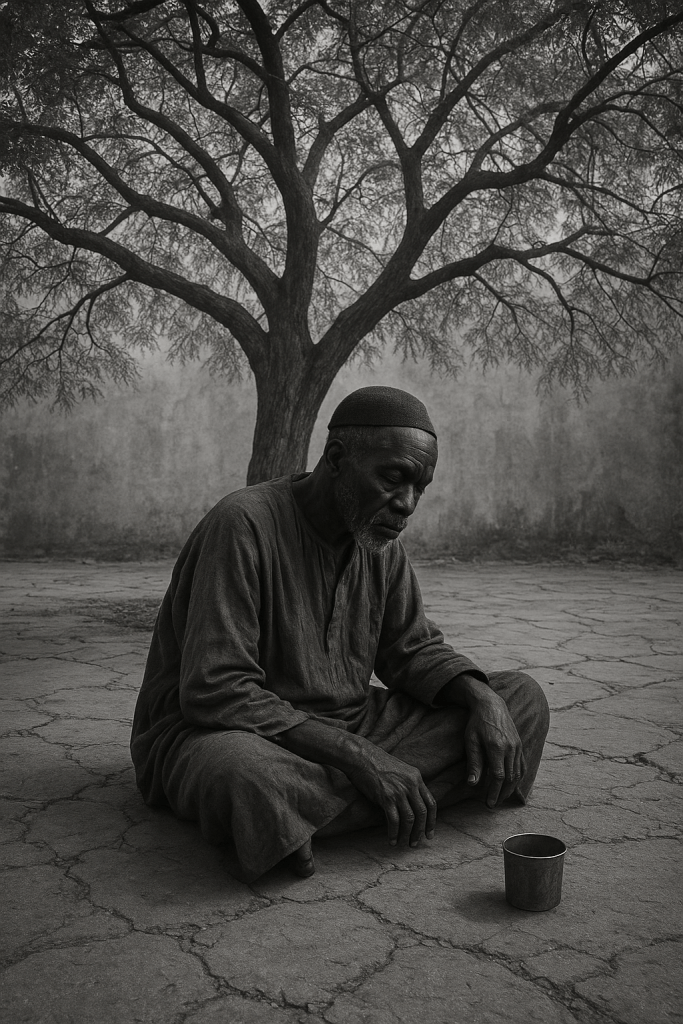
The Kano sun beat down on my weathered face, its harsh glare meaningless to my sightless eyes. The ceaseless hum of the marketplace was my symphony, the rhythmic clatter of carts, the staccato shouts of vendors, the melodic lilt of Hausa greetings. Yet, amidst this symphony, I was often deemed a discordant note.
I, Malam Idi, sat here every day, beneath the skeletal branches of a neem tree, my tin cup resting on the cracked pavement. Blindness had claimed me young, a cruel twist of fate in a land where sight was a weaver’s gold.
But I wasn’t always this way. My childhood memories, though hazy, brimmed with vibrant colours, the fiery red of hibiscus flowers, the emerald green of the Kano plains after the rain. My father, a renowned Koranic scholar, used to hold my hand, guiding me through the verses of the holy book. Then, the fever came. A relentless thief that stole not just my sight, but my entire world.
Stories. That’s what I realised I was, a repository of tales, of Kano’s history woven with personal wisdom. That day, I began to see my blindness not as a curse, but as a different lens. It allowed me to hear the whispers of the wind, to feel the city’s pulse in my bones, to hear the rhythms of those blinded by their greed and ambition. I saw resilience. I saw the strength it took to navigate a world that wasn’t built for me, a world where the echoes of the past were long silenced. But more importantly, tales of forgotten heroes, of ancient crafts, of a time when Kano was a centre of trade and tradition. But bitterness was a luxury I couldn’t afford. I saw the value I brought, a listening ear for a weary traveller, a prayer for a lost soul.
People streamed past, a constant flow of hurried footsteps. Some tossed coins with a practiced flick, barely a glance spared my way. Others quickened their pace, their noses wrinkled as if I exuded the stench of misfortune. Children, bless their innocent hearts, would sometimes toss pebbles at my cup, giggling at my startled flinch. But I knew better.
Yet, in the darkness, I found a different kind of light. The touch of the worn prayer rug beneath my calloused knees, the warmth of the Kano sun on my skin, the camaraderie of fellow beggars, these became my compass. Each clink of a coin in my metal cup wasn’t just charity, it was a validation of my existence, a testament to the silent generosity that pulsed beneath the city’s rough exterior.
My day began with the muezzin’s call, his voice a beacon slicing through the pre-dawn slumber. Soon, the rhythmic pounding of mortar and pestle would join the chorus, women preparing the day’s meals. I’d sit by the market entrance, a familiar landmark, my worn rug spread beneath me. I had a song, a Hausa praise poem I’d inherited from my father. My voice, roughened by age and grit, would rise above the city’s din;
In the name of God the Beneficent the Merciful
Let us praise Allah, the All-Merciful, the Generous,
Whose blessings shower upon us, ever wondrous,
Amada.
May peace and blessings be upon the Prophet,
The seal of Prophets, guided and exalted,
Amada.
Those who hear His call, let them respond with zeal,
And together, let us praise His name, reveal,
Amada.
Those who see the light, yet choose to stray,
Have lost their way, and will face the day,
Amada.
Empty-handed, they shall rise, a mournful sight,
For they missed the chance to see the guiding light,
Amada.
They’ll not dwell in the shade of Muhammad’s grace,
A tragic fate, lost in a hopeless space,
Muhammada.
And in the vibrant life of the city, my voice, though different, has its own melody, one of resilience and quiet strength, weaving tales of warriors and kings, of a rich past this young nation often forgot. Children, wide-eyed, would sit at my feet, transported to mythical lands. Adults, hardened by life, found solace in the echoes of their ancestors’ courage.
One day, a young man’s voice, laced with concern, broke through the market din. “Malam Idi, barka da rana?” It was Bello, the date seller, a young man with a thirst for knowledge. Unlike others, he saw beyond the ragged clothes and sightless eyes. He brought me warm gurasa and a fistful of dates, their sweetness a burst of sunshine on my tongue.
Later, a young woman stopped, her bangles tinkling a sweet melody. Her voice, soft as desert rain, asked, “What story do you sing of today, Malam?” Startled, I launched into a poem about queen Amina of Zazzau, a warrior queen who defied empires, accompanied with the gentle streaming of sarewa,played by a young Fulani lad who often sat beside me, his music a counterpoint to my voice.
From Zazzau’s heart, a queen did rise,
Amina, her name, a beacon of skies.
Amina’s spirit, a warrior’s grace,
Carved a kingdom in time and space.
With sword and shield, with hearts aflame
She forges new paths, in honour and name.
In every Hausa woman, her spirit resides,
A legacy living, where hope abides.
With grace and strength, they face the day,
Daughters of Sahel, come what may.
Preserving culture, yet reaching high,
Their legacy, a soaring sky.
From queens to mothers, daughters and wives,
Their spirit endures, through changing lives.
The woman listened; her face alight with fascination. When I finished, she placed a crisp note in my cup. It was more than a day’s earnings.
“Thank you, Malam Idi,” she said, “for reminding us of who we are. For reminding us of our strength. May your stories continue to light the way.”
Her words were a balm to my soul. They saw me not as a beggar, but as a keeper of stories, a bridge to a glorious past. I smile. For I am more than a beggar. I am a storyteller, a chronicler of life in Kano’s bustling heart.
As dusk painted the sky in hues of orange and purple, the call to prayer by the muezzin that will break his fast, before calling for adhan, echoed from the nearby minaret, its melodya subtle counterpoint to the setting sun. I gathered my meagre earnings.
The world could see me as a beggar, but I knew my worth. I was the keeper of stories, the conduit for the city’s unspoken emotions. In my blindness, I saw with a clarity that bypassed the surface. And that, I realised, was a gift far more valuable than any coin.
I was still blind, still unseen by many. But in the tapestry of the city’s sounds, I had found my place, not as a nuisance, but as a weaver of dreams, a reminder that even in darkness, stories could illuminate the way. And that, in this land of scorching sun and resilient spirit, was a worth no one could take away.
 ArtisansQuill| Celebrating Wordcraft